 In-person absentee voting will be available at your county's early voting locations on Wednesday, October 28, through Friday, October 30, 2026, from 8 a.m. to 6 p.m., and on Saturday, August 22, 2026, from 8 a.m. to 2 p.m. Tulsa County will have in-person absentee voting at four locations:
- the new Tulsa County Election Board HQ, 12000 E. Skelly Drive
- Tulsa Tech Broken Arrow Campus near 111th Street S. & 129th East Ave. (aka Florence and Olive)
- O'Brien Park Recreation Center, 6149 N. Lewis Ave.
- Chandler Park Community Center, 6500 W. 21st St.
Polls in each precinct will be open Tuesday, November 3, 2026, from 7 a.m. until 7 p.m.
NOTE: Precinct boundaries, voting locations, and district boundaries have changed, in some cases dramatically. Enter your name and date of birth on the Oklahoma State Election Board's online voter portal and you will see where to vote and your sample ballot.
In response to popular demand, I have assembled the guidance detailed below into a downloadable, printable PDF on one sheet of paper (front and back this time).
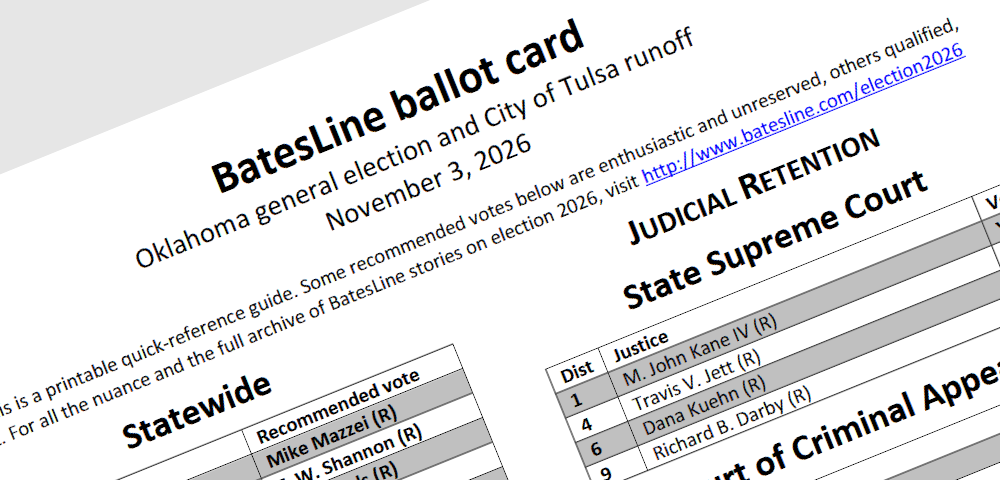
Originally posted on October 24, 2026, and postdated to remain at the top until the polls close on Election Day. I will be adding more links and detail between now and the election.
Here are the candidates I'm recommending and (if in the district) voting for in the Oklahoma general election and City of Tulsa runoff election on November 3, 2026. Click the hyperlink on the office to see detailed information on that race and its candidates. (This entry will change as I decide to add more detail, link previous articles, or discuss additional races between now and election day.)
State Questions
- SQ 845 (reform of governor appointees to Judicial Nominating Commission): YES
- SQ 847 (lower caps on property tax valuation increases): YES
Statewide Officials
Mike Mazzei was the best conservative choice for governor in the primary and runoff, and now that he faces a far-left Democrat in the general election, a vote for the candidate that supports lower taxes, more fiscally responsible state government, and school choice should be an easy call. We need a Republican governor to continue to fill court vacancies with conservative judges (one of Gov. Stitt's strongest achievements), to do better than Stitt about appointments of university regents, and to appoint strong conservatives to the State Board of Education as a check on whichever candidate is elected State Superintendent.
While any given RINO is usually better than any given Democrat, the State Superintendent race this year is a different matter. As a Tulsa school board member, the Rev. Dr. Jennettie Marshall courageously pushed for a state audit of TPS finances, which uncovered criminal wrongdoing, while most of her colleagues (including Democrat congressional nominee John "Flaky" Croisant) turned a blind eye and enabled the fraud and waste that has led to the current round of school closings. Marshall was a critic of then-Superintendent Deborah Gist and opposed the board majority's annual votes to extend Gist's contract. The liberal public ed establishment opposed Marshall in the primary and opposes her in the general, preferring Robert Franklin, the liberal pretend-Republican who considers conservative Christians hateful. I've noticed that it's easier for Republican elected officials and Republican Party officials to oppose bad ideas from a Democrat elected official than the same bad ideas coming from a Republican. While Marshall is no conservative, she has a record of holding public school officials accountable for their use of public funds and for educational results.
- Governor: Mike Mazzei (R)
- Lieutenant Governor: T. W. Shannon (R)
- Attorney General: Jon Echols (R)
- State Treasurer: Cindy Byrd (R)
- Superintendent of Public Instruction: Jennettie Marshall (D)
- Labor Commissioner: Kevin West (R)
- Insurance Commissioner: Bob Sullivan (R)
- Corporation Commissioner: Brad Boles (R)
Federal Officials
Nothing is more important this year than maintaining Republican control of both houses of Congress, however disappointing some of our individual congressmen are. A Democrat majority means the likes of Alejandra Ocasio-Cortez, Chuck Schumer, Hakeem Jeffries, and Ilhan Omar in charge of congressional committees and lots of impeachment trials. Republican majorities protect the conservative, pro-America agenda of the Executive Branch and the confirmation of more constitutionalists as Federal judges.
- U. S. Senator: Kevin Hern (R)
- U. S. House, CD 1: Mark Tedford (R)
- U. S. House, CD 2: Josh Brecheen (R)
- U. S. House, CD 3: Frank Lucas(R)
- U. S. House, CD 4: Tom Cole (R)
- U. S. House, CD 5: Stephanie Bice (R)
Every six years, voters get the chance to fire state Supreme Court justices and appellate judges. I'm recommending firing one Supreme Court justice and two Court of Civil Appeals judges, which will allow Gov. Mazzei to appoint constitutionalist replacements. Below, the judges on the retention ballot (vote yes or no on each -- they aren't running against each other), with the age, county, appointing governor, year of appointment, and party of voter registration in parentheses, followed by my recommendation.
- Oklahoma Supreme Court
- District 1: M. John Kane (64, Osage, Stitt, 2019, R): YES
- District 4: Travis V. Jett (42, Woodward, Stitt, 2025, R): YES
- District 6: Dana Kuehn (55, Tulsa, Stitt, 2021, R): YES
- District 9: Richard B. Darby (68, Jackson, Fallin, 2018, R): NO
- Oklahoma Court of Criminal Appeals
- District 2: Robert L. Hudson (69, Logan, Fallin, 2015, R): YES
- Oklahoma Court of Civil Appeals
- District 1, Office 1: Stacie L. Hixon (52, Tulsa, Stitt, 2020, R): YES
- District 1, Office 2: Jane P. Wiseman (79, Tulsa, Henry, 2005, D): NO
- District 2, Office 1: Deborah B. Barnes (72, Osage, Henry, 2008, D): NO
- District 2, Office 2: James R. Huber (58, Tulsa, Stitt, R): YES
Only three of the 14 elected district judge positions in District 14 (Tulsa and Pawnee Counties) were contested this year. Two incumbents, Caroline Wall and Kevin Gray, both registered Republicans, deserve re-election. Those seats are elected by all voters in Tulsa and Pawnee Counties.
Office 4, an open seat, is elected by only a portion of Tulsa County; Dustin Allen is by far the best qualified and the most conservative choice. His opponent, Loretta Radford, revealed her progressive politics and her support for partiality in the law during her recent stint as Legal Director for the Oklahoma City University School of Law Center for Criminal Justice. Radford has said that diversifying the bench was the "single most important goal" for the law profession in Oklahoma, and she called for "implicit bias" testing and training, imposing this DEI notion upon anyone who seeks to be a lawyer or a judge in Oklahoma. Radford lauded Joe Biden's appointment of Ketanji Brown-Jackson to the U. S. Supreme Court.
- District 14, Office 1 (Tulsa, Pawnee Counties): Caroline Wall (R)(i)
- District 14, Office 4 (Tulsa County Judicial Election District 4 only): Dustin Allen (R)
- District 14, Office 12 (Tulsa, Pawnee Counties): Kevin Gray (R)(i)
- Washington County Associate District Judge: Todd Cone (R)
State Legislature
The general rule is to vote Republican, but we want to be careful not to add crypto-liberals to the GOP caucus. That said, a crony-capitalist chamber pot is still better than a guano loco leftist.
There are a few candidates that especially deserve your support:
- House 24: Chris Banning (R)(i)
- House 79: Paul Hassink (R)
- House 98: Gabe Woolley (R)
City of Tulsa
All Tulsa voters will have a city proposition on the ballot to increase the city hotel/motel tax, but only one Tulsa City Council seat remains up for grabs.
Three seats and the City Auditor's position (Bellis, Bengel, Lakin, plus Auditor Nathan Pickard, all incumbents) were won in April when only one candidate filed. Five seats were settled in August when a candidate (four incumbents, Archie, Dutton, Gilbert, and Decter Wright, with Pete Regan winning the open District 9 seat) received more than 50% of the vote.
That leaves District 1 incumbent Vanessa Hall-Harper, who managed to upset enough of her constituents to draw five opponents. The runoff eliminated all but one opponent, TCC instructor Corinice Wilson. You can read my detailed discussion of the District 1 City Council races in my August election preview; the goal remains the same: Replace Vanessa Hall-Harper. Her campaign slogan says she's "unbought, unbossed, and unafraid," but in reality, she's Unhinged, Uncouth, and Unfit for office, as she demonstrated most recently after her failed attempt to create a 20/20 hindsight committee to second-guess Tulsa police officers.
While proponents say the proposed doubling of the city hotel/motel sales tax rate won't cost locals a penny, it puts more cash in the hands of an irresponsible city government that puts ill-conceived social programs ahead of their basic responsibilities.
- District 1: Corinice Wilson (D)
- City of Tulsa hotel tax increase: NO
Other local races
On the ballot card, I have listed county and municipal races and propositions in the Tulsa metro area, but I have not yet provided recommendations, except in Wagoner County's Oak Grove Fire Protection District, where they will vote on whether to equalize the millage in an area east of Broken Arrow that was annexed into the district at the 2024 general election. The tax rate in the older part of the district was 10 mills; this would raise the tax rate in the newly annexed area from 7 to 10 mills, or from $70 per year on a $100,000 home to $100 per year.
MORE INFORMATION:
POLLING:
There have not been any reputable public polls of Oklahoma's statewide races. Given the recent revelations about bogus polls gaining mainstream media coverage, that may be for the best.
OTHER CONSERVATIVE VOICES:
Here are some blogs, endorsement lists, candidate questionnaires, and sources of information for your consideration.
- Muskogee Politico news, questionnaires, and analysis
- Muskogee Politico judicial retention picks
- The Oklahoma State Capital (former State Rep. Jason Murphey)
- Jason Murphey judicial retention picks
- Oklahoma Constitution Index: Scores incumbent legislators on voting record
- iVoterGuide surveys of Oklahoma statewide, federal, and legislative candidates
- Tulsa County Republican Party candidate guide, with links to social media, GOP questionnaires, and GOP candidate interview transcripts
- Make Oklahoma Healthy Again (MOHA) PAC endorsements -- formerly Oklahomans for Health and Parental Rights (OKHPR)
- Oklahomans for Life candidate surveys: Oklahomans for the 2nd Amendment (OK2A)
- NRA-PVF survey grades and endorsements
- Tulsa Beacon
ANTI-CONSERVATIVE VOICES:
There are some self-styled "conservative influencers" who have shown themselves confused, inconsistent, or downright treacherous. Caveat lector. Some dash off sloppy endorsement emails filled with easily checked inaccuracies -- they're either not doing the homework or not able to understand the information they're reading. Anyone who would work to replace the only conservative on the Tulsa school board with a progressive or promote RINO Gentner Drummond for Governor, or anyone who promoted an inexperienced left-winger for District Attorney, is not someone conservatives should look to for endorsements.
If you appreciate the many hours of research that went into this guide and into the rest of my election coverage, and if you'd like to help keep this site online, you can contribute to BatesLine's upkeep via PayPal. You can also support BatesLine through a paid Substack subscription. In addition to keeping me caffeinated, donated funds pay for web hosting, subscriptions, and paid databases I use for research. Many thanks to those generous readers who have already contributed.
Finally, a reminder that there are more important things than who wins the next election. There are Two Ways to Live; choose you this day whom you will serve....
The City of Tulsa is asking voters to approve doubling the hotel tax rate in order to pay for deferred maintenance for the BOK Center and the Arvest Convention Center. At the same time, the voters, unwittingly, would be giving a massive and undeserved pay raise to the Tulsa Regional Chamber. Tulsa voters should give a big thumbs-down to the Chamberpots and insist that the City make better use of the money it already has.
If Tulsa voters say yes on November 3, the hotel tax rate will increase permanently from 5% to 9.9% on January 1, 2027, and the allocation of funds will shift temporarily toward facilities and away from marketing and tourism. The percentage for the general fund and economic development (GF and ED in the list below) will stay constant, but the percentage for marketing & tourism (M&T) will drop for four years before returning to its previous level, with Facilities getting the extra proportion. The facilities share will be pledged to cover revenue bonds to pay for arena and convention center updates, so some bankers and bond advisors will make money, too.
Funds for the BOK Center were approved by Tulsa County voters in 2003. It opened its doors in 2008. The presentation pushing for the tax increase has photos of worn seats and old-fashioned lockers. The presentation claims that $128 million in updates are needed, but only $48 million is available.
The summary of the proposal says that the current 5% generated $10.4 million in 2026. Collected at 9.9% and assuming no erosion of hotel stays, that would be $20.6 million.
- Current: 2% GF, 4.5% ED, 45% M&T, 48.5% Facilities
- 2027: 2% GF, 4.5% ED, 40% M&T, 53.5% Facilities
- 2031: 2% GF, 4.5% ED, 45% M&T, 48.5% Facilities
- After revenue bonds: 2% GF, 4.5% ED, 50% M&T, 43.5% Facilities
In constant-dollar terms, the current tax would raise $20.1 million for facilities over the next four calendar years. The proposed increase and the new proportions would turn that into $44.1 million. If $128 million is needed, that means we're looking at 12 years to retire the revenue bonds. Over 12 years the current tax and proportions would raise $60.5 million for facilities; the new tax and proportions would raise $124 million.
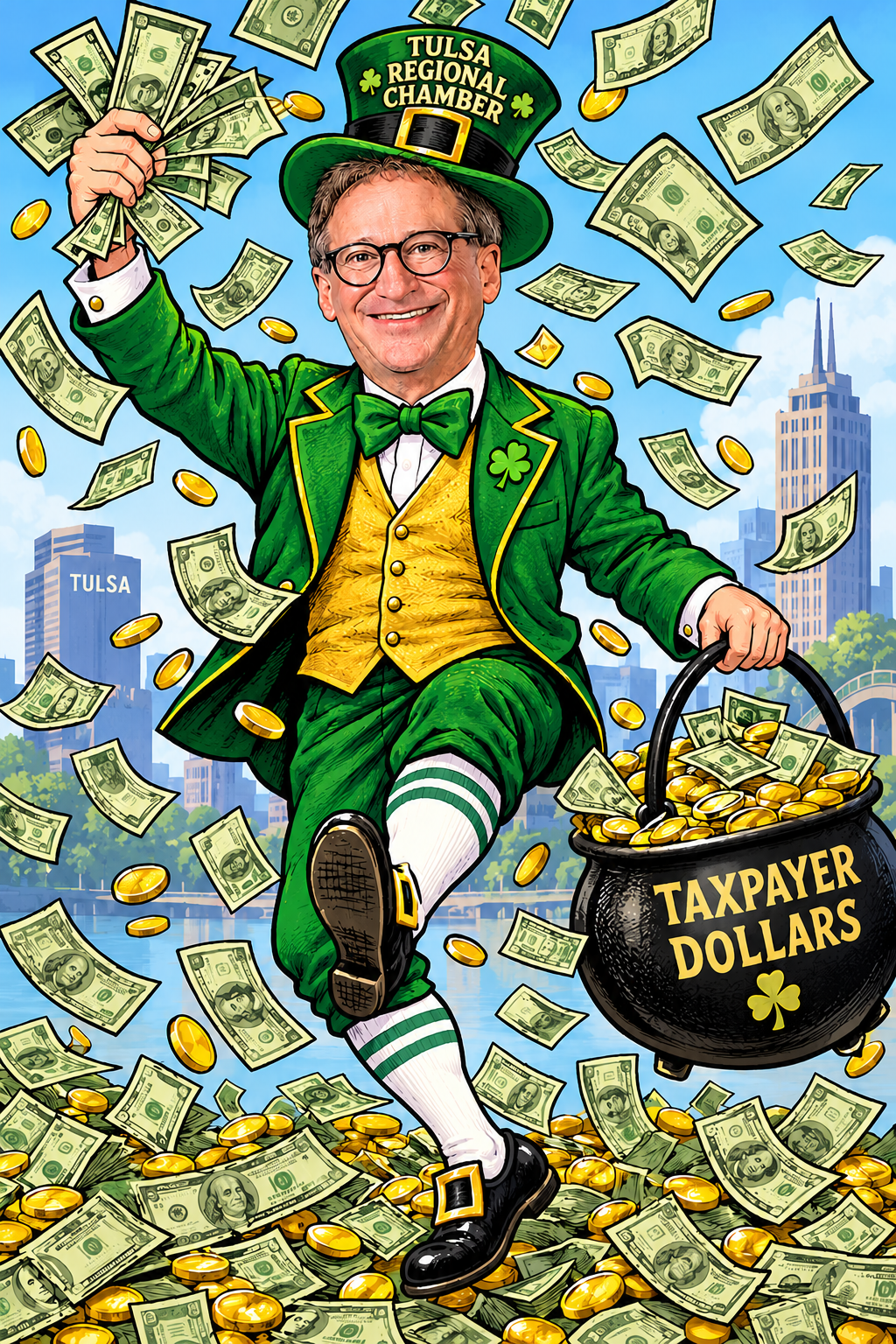 Notice how the tax increase will boost revenues for marketing and tourism and economic development, money that mostly goes to the Tulsa Regional Chamber and its subsidiaries under service contracts. Money for marketing and tourism, all of which goes to the Chamber, would rise from $4.68 million annually under the current rate and proportion to $8.24 million. Funds for economic development, of which the Chamber receives more than half, would grow from $468 thousand annually to $927 thousand. One might ask, if facility needs are so dire, why not raise the tax rate but alter the proportions so that all the increase goes to facilities?
The fund summaries in the 2026-2027 City of Tulsa budget tell the tale.
Fund 131, Convention and Visitors, is funded by 45% of the hotel tax. "The fund shall be used to market and promote tourism and the use of convention facilities within the City of Tulsa." "The City of Tulsa contracts with the Tulsa Regional Chamber of Commerce for these marketing activities." In FY27, an estimated $4,554,000 came in through the hotel tax, and all of that is budgeted to go to "Managed Entities," namely, the Tulsa Regional Chamber.
Fund 130, Economic Development, is funded by 4.5% of the hotel tax. "The funds will be used by the City for economic development activities. The City contracts with the Tulsa Authority for Economic Opportunity (TAEO) and Tulsa Regional Chamber of Commerce for economic and community development services to the City of Tulsa." Each year, $250,000 of that amount goes to "Managed Entities," namely, the Tulsa Regional Chamber.
When I think of Tulsans whose efforts have brought visitors to Tulsa, Danny Boy O'Connor is one of the first names that comes to mind. For love of the book The Outsiders and the movie based on it, he bought the old Crutchfield house used as the Curtis home in the movie and turned it into a museum and a place of pilgrimage for his fellow Outsiders fans. I think, too, of William Franklin, who built Decopolis on Route 66 and added the new Decopolis Tulsarama last year. I think of Linda Collier and her devoted care for the Cave House. What has the Chamber done to make these attractions possible?
And yet you'll see minuscule Chamber CEO Mike Neal showing up to ribbon-cuttings and grand openings as if he or the Chamber had anything to do with the hard work and creativity being celebrated. It's infuriating.
When Mike Neal and G. T. Bynum led a group of 150 Tulsans to New York for the Broadway premiere of "The Outsiders" musical, how much of the cost of that junket came from hotel/motel tax dollars? How much of that tax goes to help Neal and his staff rack up frequent-flier miles and hotel points, while doing nothing significant to build Tulsa's economy?
This hotel tax increase would be a huge gift to this entity that considers itself private when it comes to public accountability but practically a branch of government when it comes to entitlement to government revenues. Unfortunately, we don't have any city councilors with the courage to examine whether dollars sent to the Chamber are effective in increasing tourism and tourist spending. The diminutive mediocrity who specializes in gripping, grinning, and cutting ribbons will be very pleased if voters approve a near-doubling of his annual budget. Back when we had courageous city councilors, they pushed for competitive bidding and other reforms for convention and tourism promotion and economic development, but the reform ordinance they passed was vetoed by then-Mayor Bill LaFortune.
The City had a fair amount of extra money to play with recently. The Vision Tulsa sales tax ran a $103 million surplus. That money was intended for economic development and capital improvements, but the Council and Mayor Monroe Nichols repurposed $23 million of it for the Homeless Industrial Complex. More money for the Philanthropocrats.
In the real world, owners of theaters, restaurants, nightclubs, and other venues hold back some of their profits to pay for repairs, renovations, and updates needed to continue to attract customers. A hotel that fails to replace wallpaper and bed linens and to keep the mechanical systems in good working order will find itself losing its franchise agreement and sliding down the hierarchy of hotel chains, cutting rates and losing desirable customers on the way: Hilton becomes Clarion becomes OYO becomes burned-out squatter nest. But in government world, operating contractors and tenants keep all the ticket profits, and the taxpayers have to pay for updates.
Proponents claim that this is the only tax that you don't pay, except that you pay this tax in other cities, and an increase in one city enables increases in other cities. Tulsans may wind up paying part of the this tax by one degree of separation: Out-of-town contractors who come to Tulsa to do work and provide services for Tulsa businesses and residents will pay the higher hotel tax and pass the extra expense on to the locals who hired them.
Rather than put the burden of convention and sports facilities on travelers, most of whom are just passing through or perhaps in town to visit family, why not directly tax those who attend events at the BOK Center and the Convention Center to fund updates?
Tulsans should say NO to any hotel tax increase until the City puts convention, tourism, and economic development services up for competitive bid and until the City gets its budget priorities in order.
Here is the gist that will appear on the November 3, 2026, ballot:
Do you approve Ordinance No. 25830, which increases the levy of an excise tax from five percent (5%) to nine and nine-tenths percent (9.9%) upon the gross proceeds or gross receipts derived from the rent from every occupancy of a room or rooms in a hotel in this City and establishes an effective date of January 1, 2027?
Ordinance No. 25830 was approved by the Tulsa City Council on July 22, 2026. It was approved unanimously by the seven councilors present (Hall-Harper and Bush were absent) It modifies paragraph A of Title 44, Section 101 as follows (deletions are shown with strikethroughs, additions with underlines:
There is hereby levied an excise tax of
five percent (5%)nine and nine-tenths percent (9.9%) upon the gross proceeds or gross receipts derived from the rent from every occupancy of a room or rooms in a hotel in this City, except that the tax shall not be imposed where the rent is less than at the rate of Ten Dollars ($10.00) per day.
There are no other changes to the rest of Section 101, which defines other exemptions (e.g., for veterans and government agencies), and Section 100, which defines what a hotel is. The council tweaked the definition of taxable rent in 2024 and 2025 to exclude taxes, parking fees, food and beverage, late checkout fees, rollaway crib charges, and other add-ons.
If voters approve the tax increase, another ordinance, also approved unanimously on July 22,will go into effect on January. Section 118 of Title 44, which defines how the hotel tax money is to be spent, will be changed as follows:
 Two district judgeships will be on all of Tulsa and Pawnee Counties' November 3, 2026, ballots. Voters in the eastern Tulsa County portion of the City of Tulsa and Tulsa County north of the City of Tulsa (Skiatook, Collinsville, Sperry, Owasso) will have a third judicial choice to make.
Just north of us, Washington County will elect a new Associate District Judge to replace Russel Vaclaw, who won a District Judgeship in District 11 without opposition.
Here are my recommendations, and my friends in the legal community appear to be unanimous in agreement:
- District 14, Office 1 (Tulsa, Pawnee Counties): Caroline Wall (R)(i)
- District 14, Office 4 (Tulsa County Judicial Election District 4 only): Dustin Allen (R)
- District 14, Office 12 (Tulsa, Pawnee Counties): Kevin Gray (R)(i)
- Washington County Associate DJ: Todd Cone (R)
Oklahoma is divided into 26 judicial districts. Tulsa County shares its 14 district judges with Pawnee County in Judicial District 14. Additionally, each county elects one associate district judge, who serves along side the district judges. The only real distinction is the geography of the constituency. Since the passage of HB 1504 in June 1993, District 14 has five judges nominated and elected by a district within Tulsa County, a judge nominated in Pawnee Couty and elected at-large, and the remainder of judges nominated in Tulsa County and elected at-large. District judges run in competitive non-partisan elections for four year terms.
For Office 1, incumbent District Judge Caroline Wall faces Tom Sawyer. Wall served a term as Associate District Judge for Tulsa County from 2002 to 2006. She was defeated for re-election in 2006 by then-Associate District Attorney Dana Kuehn (who is on this year's ballot as a Supreme Court justice seeking retention). (Wall was not happy about my endorsement of Kuehn.) In 2014, Wall defeated incumbent soft-on-crime judge William Kellough to return to the Tulsa County bench, and by all accounts is a solid judge, vastly improved over her first term of office.
In 2023, Wall dismissed a lawsuit for reparations for the Tulsa Race Massacre for failure "to state a justiciable public nuisance claim" and "to allege a cognizable legal abatement remedy." In her order dismissing the case, Wall wrote, "This court declines to engage in the management of public policy matters that should be dealt with by the legislative and executive branches." She was attacked for her decision by the Black Wall Street Times, who reported that she had ties to far-right wing characters and followed Donald Trump on Twitter. The dismissal was upheld in 2024 by the Oklahoma Supreme Court (OSCN docket here) by an 8-1 majority: "We affirm the District Court's July 12, 2023 Final Order of Dismissal with Prejudice. With respect to their public nuisance claim, though Plaintiffs' grievances are legitimate, they do not fall within the scope of our State's public nuisance statute. We further hold that Plaintiffs' allegations do not sufficiently support a claim for unjust enrichment, nor do the allegations sufficiently support a claim for the unauthorized use of name and likeness under 12 O.S. § 1449."
Wall was challenged by Tom Sawyer (full legal name, Scott Thomas Sawyer) in 2018, and Sawyer is running again this year. Sawyer earned his law degree at Loyola in Los Angeles and has been working in Oklahoma since 2013, serving stints as an Assistant DA in a variety of counties, including Tulsa, Creek, Choctaw, and Mayes. Sawyer ran for the Rogers County associate district judge post in 2022. Sawyer does not appear to be actively campaigning, and he has not filed with the Oklahoma Ethics Commission for this campaign. In 2018, he received $500 donations from Gentner Drummond and Daniel Smolen.
Both Wall and Sawyer are registered Republicans.
In Office 12, District Judge Kevin Gray, a former assistant district attorney first elected judge in 2022, has been challenged by Christopher Camp. Camp, a lawyer in private practice, is not running an active campaign and has not filed with the Oklahoma Ethics Commission. Gray and Camp are both registered Republicans, but Camp only ever votes in November general elections.
Office 4 was the only open competitive seat this year, replacing retiring judge Daman Cantrell. Three candidates filed, Phillip Peak was eliminated in the June primary, and now assistant DA Dustin Allen and special judge Loretta Radford are on the November ballot. The election will take place only within Tulsa County Judicial Election District No. 4, which can be roughly described as north Tulsa County and east City of Tulsa. Here is the official map of Tulsa County judicial election districts.
If you want judges who believe in Equal Justice Under Law, Dustin Allen is the only choice for Office 4.
Dustin Allen is private practice attorney. Allen has been endorsed by State Rep. (and likely future Congressman) Mark Tedford, Tulsa County Sheriff Vic Regalado and a long list of area FOP chapters. His LinkedIn profile says that Allen worked as an ADA in Tulsa County for 9 months, as a Tulsa County Assistant Public Defender for 3 years and 1 month, and as an ADA in Wagoner County for 6 months, covering the period from June 2011 to July 2015, when he began private practice. According to voter and land records, Allen lived near 91st and Memorial before purchasing a home in Owasso, in Election District 4, in 2025. Allen is an alumnus of Bishop Kelley High School and got his law degree from Hofstra. You can get a sense of Allen's demeanor, philosophy, and values from his YouTube channel.
Radford has been endorsed by Judge Cantrell and has among her donors local Democrat figures like Tim Gilpin, Jim Frasier, and John Nicks, as well as former judge William Kellough, who was ousted for being soft on crime in 2014 (see above). According to voter and land records, Radford has had a home in Owasso since 2004.
Looking back a few years, in June 2022 Radford was a Democrat registered to vote in Owasso, while Allen was a Republican registered to vote in south Tulsa. The same was true in November 2018. In the 2024 presidential election, District 4 votes supported Donald Trump over Kamala Harris by 63.4% to 34.5%, so the election ought to be a slam dunk for Allen as long as voters get the word that Allen is a conservative and Radford supports race preferences in our legal system, as detailed below.
What follows regarding Radford's record is largely a repeat from before the June primary, but it's worth repeating for those just now tuning in.
All Oklahoma voters will have 9 judicial retention questions on the November 3, 2026, ballot. Unlike district judges, where competitors run in non-partisan elections, justices of the Oklahoma Supreme Court and judges on the Oklahoma Court of Criminal Appeals and Oklahoma Court of Civil Appeals are appointed, but face a yes-or-no retention ballot every six years. (I think unopposed district judges should also face a retention ballot.)
Oklahoma has two separate appeals systems. Civil cases go through the Oklahoma Court of Civil Appeals and can be appealed from there to the Oklahoma Supreme Court, while the Court of Criminal Appeals is the apex of Oklahoma's criminal court system. (Here is a flowchart showing how these appellate courts are related to one another and to district and municipal courts.)
Every appeals judge or justice is appointed by the governor from a list of three provided by the Judicial Nominating Commission, a panel of 15 consisting of six attorneys selected by the Communist-enabling Oklahoma Bar Association, six non-attorneys appointed by the Governor (of which only three can be Republican), and three further non-lawyer members appointed by those twelve.
Passage of SQ 845 would give a conservative governor a more conservative Judicial Nominating Commission and should result in a more conservative list of candidates from which Governor Mazzei can choose as he fills court vacancies.
A newly appointed Supreme Court justice or appellate judge faces a retention ballot at the next general election, and once again at the general election when the term for his seat expires (which may be two, four, or six years later), then voters have the opportunity to oust him every six years thereafter. The next retention elections, in the absence of a resignation, death, or new appointment:
2026 (cycle 1): Supreme Court 1, 6, 9; Civil Appeals Districts 1, 2; Criminal Appeals District 2, 3
2028 (cycle 2): Supreme Court 2, 5, 8; Civil Appeals Districts 3, 4; Criminal Appeals District 1
2030 (cycle 3): Supreme Court 3, 4, 7; Civil Appeals Districts 5, 6; Criminal Appeals District 4, 5
Cycle = ( (Election Year - 1910) / 2 ) modulo 3
An office will be on the ballot off-cycle when a vacancy occurs and a replacement is appointed, as with Supreme Court District 4 Justice Travis Jett, appointed in 2025 to replace ousted Justice Yvonne Kauger. If retained, Jett will face the voters again in 2030.
Less frequently, an office will not be on the ballot when its term expires because a judge has decided not to file for retention. That's the case this year with Court of Criminal Appeals District 3 Judge Gary Lumpkin; instead, the governor will appoint a replacement this year who will be on the ballot at the next general election in 2028 and then, if retained, will be on the ballot again when the District 3 term expires in 2032.
I was puzzled that Civil Appeals Judge Jim Huber, who was appointed to the court in 2023 and on the 2024 retention ballot would be on the ballot again just two years later. That puzzlement led me to dig deeper, to notice that the law establishing the retention ballot for this court, 20 O. S. 30.18, like the constitutional changes instituting the retention ballot for the Supreme Court and Court of Criminal Appeals, continued the existing fixed, staggered six-year terms for each office. From past election results and this helpful list of past Criminal Appeals judges showing each year that a judge was re-elected, a pattern emerged, which you see above.
In the 58-year history of Oklahoma's judicial retention elections, only one judge or justice has ever been turned out of office by the voters: Supreme Court Justice Yvonne Kauger in 2024.
Here is the list of appellate judges on the 2026 retention ballot. In parentheses, I list age on election day, county of residence, appointing governor, year of appointment, and party of voter registration, followed by my recommendation at this point.
Supreme Court
- District 1: M. John Kane (64, Osage, Stitt, 2019, R): YES
- District 4: Travis V. Jett (42, Woodward, Stitt, 2025, R): YES
- District 6: Dana Kuehn (55, Tulsa, Stitt, 2021, R): YES
- District 9: Richard B. Darby (68, Jackson, Fallin, 2018, R): NO
Court of Criminal Appeals
- District 2: Robert L. Hudson (69, Logan, Fallin, 2015, R): YES
Court of Civil Appeals
- District 1, Office 1: Stacie L. Hixon (52, Tulsa, Stitt, 2020, R): YES
- District 1, Office 2: Jane P. Wiseman (79, Tulsa, Henry, 2005, D): NO
- District 2, Office 1: Deborah B. Barnes (72, Osage, Henry, 2008, D): NO
- District 2, Office 2: James R. Huber (58, Tulsa, Stitt, R): YES
(Recommendations for the competitive, non-partisan elections for District Judge in the Tulsa area will be in a separate entry.)
Jamison Faught, the Muskogee Politico, has published his judicial retention picks for 2026. We differ only on Justice Darby, but neither of us consider Darby's retention a clear-cut choice.
I haven't yet seen a column about this year's retention ballot from former State Rep. Jason Murphey, but his 2024 column provides helpful perspective on the damage to our courts perpetrated by Brad Henry's eight years as governor. A lefty-lawyer Democrat in the governor's office being fed nominees by a lefty-driven JNC is a bad combination for justice.
After the jump, the basis of the recommendations.
Tulsa's Mean Girls clique, the group of four city councilwomen who text each other during meetings to mock citizens and fellow councilors, were the only four yes votes on Wednesday to create an independent commission to pass judgment on Tulsa's police officers. The proposed ordinance failed by a vote of 4-4-1:
- Yes: Vanessa Hall Harper (District 1), Jackie Dutton (District 3), Laura Bellis (District 4), Lori Decter-Wright (District 7)
- No: Karen Gilbert (District 5), Christian Bengel (District 6), Phil Lakin (District 8), Carol Bush (District 9)
- Abstain: Anthony Archie (District 2)
Independent oversight commissions have become a popular fad in liberal cities, particularly since the Black Lives Matter movement and the George Floyd incident of 2020. The concept behind these commissions is that All Cops Are Bastards (if you've seen the acronym ACAB, that's what it means) and therefore we need people with no clue about standard police practice to second-guess, in leisurely hindsight, the split-second decisions made by police officers dealing with crisis situations involving unstable and dangerous people. Proponents hope that awareness of this second-guessing will cause police officers to hesitate to enforce the law, particularly if the apparent perpetrator is from a protected ethnic group. An axiom of the theory behind these commissions is that arrest numbers vary across socioeconomic and demographic groups only because cops are racist; it couldn't possibly be because of variations in the frequency of criminal behavior across groups. These commissions are part of the standard kit for converting your city from an orderly, clean, and prosperous place to a chaotic and dangerous hell-hole. (A pro-criminal district attorney is also a component in the kit; we narrowly escaped that fate in June.)
The proposal was ridiculously complex. For all the claims that this would promote transparency and accountability, the director of the Office of Independent Review and Oversight of Public Safety (OIROPS) would be in the "classified service" -- protected from public accountability by civil service rules. The seven members of the OIROPS Advisory Board would be handpicked by the Mayor, as would the eleven members of the Citizens Oversight Board, which would oversee the Advisory Board.
The City Council, directly accountable to the voters, has power under the Tulsa City Charter to oversee any aspect of city government. From Article II:
Section 16. - Review of administrative actions.The Council shall provide by ordinance for the grant, issuance, modification, amendment, or revocation of orders, licenses, permits, certificates, and approvals by the divisions, departments, and agencies of the city. Except when otherwise provided by the laws of Oklahoma, the grant, issuance, modification, amendment, or revocation of orders, licenses, permits, certificates, and approvals shall be subject to review by the Council, upon petition by an aggrieved person, in accord with procedures which the Council shall establish by ordinance. The Council may not abrogate any right of review by a court of competent jurisdiction.
The Council may investigate the conduct of the city government and may make appraisals, comments, and recommendations to the Mayor on the efficiency, economy, and effectiveness of administrative practices, methods, systems, and controls. The Council shall hear complaints made by citizens concerning the administration of the city government. The Council may subpoena witnesses, administer oaths, and compel testimony, the production of books, papers, or other evidence necessary for the discharge of the duties of the Council. The Mayor shall designate police officers to serve orders and subpoenas issued by the Council. The Council shall provide by ordinance the penalties for the contempt by any person who refuses to obey a Council order or subpoena.
But that's too much hard work for this Council.
For the record, here is item 7.c. on the Tulsa City Council's October 14, 2026, 5 pm regular meeting agenda:
c. Consideration and possible approval, adoption, denial, amendment or revision of an Ordinance adopting a new Title 16, Tulsa Revised Ordinances, titled "Independent Review and Oversight of Public Safety"; creating the Office of Independent Review and Oversight of Public Safety and the position of Director; establishing the powers, duties, responsibilities, qualifications, and reporting requirements of the Office and Director; providing for the review and oversight of certain Public Safety investigations; providing for confidentiality of certain information and records; creating a civilian oversight board and establishing its membership, qualifications, terms, powers, duties, meetings, and reporting requirements. (Hall-Harper, Decter Wright) [PW 9/16/26; CC 9/16/26; BUD/SP 9/23/26; CC 9/23/26; UED 9/30/26; UED 10/14/26; CC 10/14/26] 26-734-6
Vanessa Hall-Harper and Lori Decter Wright are the authors of the ordinance. The list at the end indicates the committee meetings and council meetings at which the ordinance was heard. PW is Public Works, BUD is budget, UED is urban and economic development. There is a set of supporting documentation:
- the September 14, 2026, version of the proposed ordinance
- a presentation on the proposal
- a comparison of the structure and powers of Oklahoma City's Community Public Safety Advisory Board with the proposed Tulsa Office of Independent Review and Oversight of Public Safety
- a half-million dollar budget for the new Office
- City of Tulsa salary and benefits by department and pay grade for FY 2026-27 and FY 2027-28
- the May 2022 presentation report from the Council Trust & Accountability Working Group
That last item includes the 2019 proposal for an Office of Independent Monitor (OIM), which specifically targeted the Tulsa Police Department, and includes a 2022 report by the working group describing the TPD "reforms" that they were considering. The working group consisted of Hall-Harper, Decter Wright, and the District 5 Councilor Mykey Arthrell-Knezek -- apparently a hyphenated or double-barrelled last name was a requirement for participation. The report is useful documentation that this idea of an OIM came from then-Mayor G. T. Bynum, who pretended to be a conservative Republican when first running for council (parading his brief period of service in Tom Coburn's Senate office as evidence of his conservative bona fides), but showed his true rainbow-flag colors once in office.
That 2022 report and presentation is proof that bad ideas never completely die, and we can expect to see this one return unless we clean out the City Council. Unfortunately, the 2026 City of Tulsa general election happened on August 25, in which three councilors were re-elected without opposition, four councilors won re-election with an absolute majority, and one new councilor won an open seat with an absolute majority (Pete Regan in District 9, the 2004 Democrat Lt. Gov. nominee).
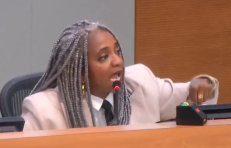 The lone opportunity to replace one of the malign influences on the City Council falls to District 1. Corinice Wilson finished second in the August 25 election to incumbent Vanessa Hall-Harper and the two have advanced to a November 3 runoff. Hall-Harper reacted badly to the defeat of her proposal with a rant. Reality Snark on X has the clip and a transcription:
"...but, then you got to understand.. from an historical perspective in this country that's intentional...That's why only historically who can engage and participate in government, WHITE MEN WITH LAND" That is the history...cause I'm a history teacher... That is the history...You obviously haven't read a book (to audience member who disagreed). History bears that out, and it still is apropos today---thats just the reality of it and we are still reeling from it today."
Hall Harper claims to be "unbought and unbossed," but unhinged would be a more appropriate term, given this performance and earlier outbursts like her use of a racist slur to denounce U. S. Sen. Tim Scott or her rant condemning the Tulsa city flag as racist.
And what about that abstention from professed Republican Anthony Archie, who represents Tulsa west of the river and the western part of south Tulsa? During his first run for office in 2024, I wrote:
...Archie was a registered independent as recently as April 2023, changing his registration sometime between then and last December, and his wife is a registered Democrat. Archie has a lot of endorsements that are negative indicators -- Tulsa World, Karen Keith, the Tulsa Chamber's TulsaBizPAC -- and he seems poised to fall in line with Phil Lakin and the rest of the establishment uniparty at City Hall. In March 2023, Archie called for passage of the George Floyd Justice in Policing Act, a Federal bill, backed by the Democrats, that would have nationalized Blue city policies that make police officers hesitant to be pro-active, resulting in an explosion of crime and disorder.
District 2 is one of the more conservative sections of Tulsa. There needs to be an active effort by conservatives, starting today, to find a reliable conservative to replace Archie on the Council in 2028. Ideally, that would be part of a broader city-wide effort to recruit and elect conservatives to the Council. It would be awesome if the Tulsa County Republican Party would take the lead in that effort, but they'd have to develop a selection process by which the party would evaluate and back one candidate in each race, even if more than one registered Republican is running.
The county party established a candidate evaluation committee for the 2024 election, and I was appointed to serve on it. Strangely, after Anthony Archie appeared before the committee, the committee was never reconvened to make endorsements, and county party leaders failed to endorse Brent Van Norman for mayor until a week before the election, feeling that the rules did not permit them to make a recommendation in a race with multiple registered Republicans. (They waited for other registered Republican candidates to give their permission for the Tulsa County GOP to endorse Van Norman.) In the UK, Australia, New Zealand, and many other countries that don't have party primaries, parties have an internal process for interviewing, screening, and selecting candidates. The Oklahoma GOP or the Tulsa County GOP could look to those processes for ideas in establishing rules established to create a process for party selection of candidates for "non-partisan" offices, in which there are no party primaries.
Once again, Oklahoma voters are being asked to place a lengthy and detailed piece of legislation in our State Constitution which properly belongs in a more easily amendable statute. The Constitution withholds the authority to regulate and adjust exemptions, valuations, and tax rates except as very specifically provided in bloated Article X. Nevertheless, State Question 847 would grant all Oklahomans additional protection against tax increases by inflation and would expand the universe of senior citizens granted additional relief. For that reason, I'm voting YES on SQ 847.
Your property tax bill is the product of two numbers: The assessed value times the total millage rate (in mills per dollar, i.e., dollars per thousand dollars) that you've authorized your local taxing authorities to take. The assessed value is the fair cash value times an assessment rate (11% in Tulsa County), minus the homestead exemption ($1,000), if the property is a homestead.
where
- FCV = fair cash value
- AR = assessment ratio (a constant in Tulsa County = 11%)
- HE = homestead exemption (a constant = $1,000; low-income homeowners qualify for an additional $1,000 homestead exemption)
- TM = total millage (the sum of property tax rates affecting the property -- school, city, county, library, health department, community college, technology center, etc.)
AR and HE have been constant for a long time and are unlikely to change. Practically speaking, your taxes will go up or (rarely) down depending on changes in fair cash value and total millage. Total millage will go up if there's a new school bond issue or if your city or county government has to pay a lawsuit settlement. Fair cash value depends on the market, as interpreted by the County Assessor. When demand causes local home prices to skyrocket, you become liable for higher taxes based on gains you can't realize without selling your home.
To protect taxpayers from tax hikes caused by housing inflation, in 1996 Oklahoma voters approved a 5% cap on the annual increase in fair cash value and a valuation freeze for senior citizens with gross incomes below $25,000 (SQ 677). This was the origin of the two sections (8B and 8C) of Article X that would be changed by SQ 847. In 2005, voters increased the income limit for the senior citizen valuation freeze to the estimated median income for the county or metro area, as reported by the US Department of Housing and Urban Development (HUD) (SQ 714). In 2012, voters reduced the cap on the annual increase in fair cash value for homestead properties to 3% (SQ 758).
SQ 847 would cut the general cap on fair cash value increase from from 5% to 4%, the homestead cap from 3% to 1.75%. It would also graduate the phase-out of the senior valuation freeze: Instead of a hard cutoff at the median income, there would be four brackets based on estimated median income (EMI), reducing the increase cap to zero as income goes down:
- 100%-120% of EMI: 0.35% cap on annual FCV increase
- 120%-140% of EMI: 0.70% cap
- 140%-160% of EMI: 1.05% cap
- 160%-180% of EMI: 1.40% cap
HUD doesn't quite use the same terminology as the Oklahoma Constitution. Median Family Income in the Tulsa Metropolitan Statistical Area (MSA), as issued by HUD for Fiscal Year 2026, is $95,000. Here is the page for 2026 data, and here is a direct link to the spreadsheet. Assuming that number is being used, senior households with gross incomes below $171,000 would get some additional relief beyond that which would apply to all homeowners.
That was the gist of the gist. Here is the 304-word "gist" of SQ 847, as it will appear on your November 3, 2026, ballot.
STATE QUESTION NO. 847 LEGISLATIVE REFERENDUM NO. 381This measure amends article 10, sections 8B and 8C of the Oklahoma Constitution.
Currently, section 8B limits annual growth in fair cash value to 5% for most real property or 3% for homesteads and agricultural land. If approved, the measure would limit annual growth in fair cash value for tax year 2027 and after to 4% for most real property or 1.75% for homesteads and agricultural land. Currently, section 8C prohibits any increase in fair cash value of homestead property for persons age sixty-five (65) or older whose income does not exceed certain limits, sometimes referred to as the senior freeze. Instead of prohibiting any increase in fair cash value for these homesteads, there would be an annual limit of 1.75%. The measure eliminates the income cap on gross household income to qualify for the senior freeze. If approved, the annual limit on an increase in fair cash value would be tied to how much gross household income the homestead owner had in the preceding year. If a homeowner's gross household income from the previous year was at or below the median income for their county or area (as determined by the U.S. Department of Housing and Urban Development's estimated median income amount for the county or metropolitan statistical area), a homeowner's homestead fair cash value cannot be increased. If the income amount was in excess of certain thresholds, the limit on increases in fair cash value for homesteads owned by persons age 65 or older could be 0.35% (income over 100% up to 120%); 0.7% (income over 120% up to 140%); 1.05% (income over 140% up to 160%); 1.4% (income over 160% up to 180%); or 1.75% (income over 180%). If passed, this measure would have a fiscal impact on the state, but the exact impact is unknown.
Shall the proposal be approved?
Although I hate including this kind of statutory detail in the State Constitution, a recent Oklahoma Supreme Court decision (read below regarding SQ 843 for the details) means any property tax relief will require spelling it out in the Constitution, at least until we end the activist majority on the court.
Because we're all about the details here at BatesLine, here is the text of Article X, Sections 8B and 8C as they would be modified by passage of SQ 847, with deleted text struck through, added text underlined, and everything else unchanged:
SQ 845 is a half-measure, but this half-measure is better than none. The Oklahoma Constitution grants a formal role to the Oklahoma Bar Association, a left-leaning private cartel, in filtering appellate court nominees in Oklahoma, unelected and unaccountable figures restricting the choices available to the duly elected governor. State Question 845, one of two statewide referenda on the Oklahoma November 3, 2026, general election ballot, doesn't eliminate that filter or the cartel's involvement, but it does make it possible for conservative lawyers to be involved in the nomination process, something effectively impossible under current law.
SQ 845 would make minor changes to the membership of the board that provides the governor with his options for filling judicial vacancies. It would not correct two very big problems with the judicial nominating process and the private, left-wing organization embedded in that process. SQ 845 was proposed by the legislature as HJR 1024. (I discussed the problems with the current judicial nomination process in this 2024 article in support of reform.)
On July 11, 1967, Oklahoma voters narrowly approved SQ 447, which added a new Article 7B to the Oklahoma Constitution, completely revamping the method of selecting appellate judges, creating a Judicial Nominating Commission (JNC) to nominate appointees for the Court of Civil Appeals, the Court of Criminal Appeals, and the Oklahoma Supreme Court and to fill vacancies in District Courts between elections. (The vote was Yes 86,183, 52.1%; No 79,280, 47.9%) This was a reaction to the 1965 revelation that multiple Oklahoma Supreme Court justices had received bribes over more than two decades. In 2010, voters approved SQ 752 (Yes 606,805, 62.8%; No 358,925, 37.2%), which tweaked the composition of the JNC to include two additional non-lawyer, at-large members and to ban relatives of attorneys from serving in the "lay member" seats on the JNC.
The "professionalization" of the judiciary replaced partisan direct election of appellate judges and justices with appointments made through a complex process involving the Oklahoma Bar Association, even though none of the reforms directly addressed the causes of the scandal. A commission, composed of non-lawyers appointed by the Governor and lawyers appointed by the Oklahoma Bar Association, chooses three nominees to place before the Governor, who may appoint one of those three. The voters don't get to weigh in on the new appellate judge or justice until the next general election, when they have an up-or-down vote to retain or dismiss the new judge. (District and Associate District Judge appointees serve until the next judicial election, when they file and run as normal and may face opponents.) Voters have voted against retention only once, dismissing Supreme Court Justice Yvonne Kauger in the 2024 election.
Here is the text of Article VII-B, Section 3, as it would be amended by SQ 845, with additions shown as underlined text and deletions as strikethrough:
Section 3. (a) There is established as a part of the Judicial Department a Judicial Nominating Commission of fifteen (15) members, to consist of:(1) six members to be appointed by the Governor, which shall include at least one from each congressional district
established by the Statutes of Oklahoma and existing at the date of the adoption of this Article, none of whom shall be admitted to practice law in the State of Oklahoma or have any immediate family member who has been admitted to the practice of law in the State of Oklahoma or any other stateas such congressional districts exist as of the date of the appointment. Each member appointed pursuant to the provisions of this paragraph shall serve a term of six (6) years;(2) six members, which shall include at least one from each congressional district
established by the Statutes of Oklahoma and existing at the date of the adoption of this Articleas such congressional districts exist as of the date of the selection who are, however, members of the Oklahoma Bar Association and who have been elected by the other active members of their district under procedures adopted by the Board of Governors of the Oklahoma Bar Association, until changed by statute. Each member appointed pursuant to the provisions of this paragraph shall serve a term of six (6) years; and(3) three members at large
who shall not have been admitted to the practice of law in the State of Oklahoma or any other state or have any immediate family member who has been admitted to the practice of law in the State of Oklahoma or any other state but whoeach of whom shall be a resident of the State of Oklahoma, one to be selected by not less than eight members of the Nominating Commission. In the event eight members of the Commission cannot agree upon the member at large within thirty (30) days of the initial organization of the Commission or within thirty (30) days of a vacancy in the member at large position, the Governor shall make the appointment of the member at large; one to be selected by the President Pro Tempore of the Senate; and one to be selected by the Speaker of the House of Representatives.No more than two members at large shall belong to any one political party.Each member appointed pursuant to the provisions of this paragraph shall serve a term of two (2) years.(b) The Commission shall elect one of its members to serve as chair for a term of one (1) year.
(c)
The six lay members of the Commission who are appointed by the Governor shall be appointed within ninety (90) days from the date that this Article becomes effective. Two members shall be appointed for a term of two (2) years, two members for a term of four (4) years, and two members for a term of six (6) years. The Oklahoma Bar Association shall hold its election and certify to the Secretary of State its members within ninety (90) days from the effective date of this Article, two of whom shall be elected for a term of two (2) years, two for a term of four (4) years, and two for a term of six (6) years. Thereafter allAll of the members of the Commission, whether elected or appointed, shall serve for a term of six (6) years, except that the member at large shall serve for a term of two (2) years.
(b)(d) Vacancies arising during the term of anylaycommissioner, other than the member at large, shall be filled by appointment by the Governor for the remainder of his or her term. Vacanciesof any lawyer commissionerin positions elected pursuant to the procedures established by the Oklahoma Bar Association shall be filled by the Board of Governors of the Oklahoma Bar Association for the remainder ofhis or herthe applicable term.
(c)(e) In the event of vacancy in any of the member at largepositionpositions, the said vacancy shall be filled in the same manner as the original selection.
(d) Of those Commissioners named by the Governor, not more than three shall belong to any one political party.
(e)(f) The concurrence of the majority of Commissioners in office at the time shall be sufficient to decide any question, unless otherwise provided herein. The Commission shall have jurisdiction to determine whether the qualifications of nominees to hold Judicial Office have been met and to determine the existence of vacancies on the Commission.
(f)(g) No Commissioner, while a member of the Commission, shall hold any other public office by election or appointment or any official position in a political party and he or she shall not be eligible, while a member of the Commission and for five (5) years thereafter, for nomination as a Judicial Officer.
(g)(h) Commissioners shall serve without compensation but the Legislature shall provide funds to reimburse them for their necessary travel and lodging expenses while performing their duties as such Commissioners.
(h)No Commissioner shallbe permitted to succeed himself or herselfserve more than twelve (12) consecutive years, whether elected or appointed.(i) As used herein, the words "Oklahoma Bar Association" shall include any successor thereof and any future form of the organized Bar of this state.
(j) The modifications to the provisions of this section pursuant to Enrolled House Joint Resolution No. 1024 of the 2nd Session of the 60th Oklahoma Legislature shall be applicable to any position on the Judicial Nominating Commission that ends by expiration of the term of office or by vacancy.
The gist that will appear on the ballot:
This measure amends Section 3 of Article 7-B of the Oklahoma Constitution. It changes provisions related to the Judicial Nominating Commission. It updates references so appointments made by certain persons based on the congressional districts would be made using the current congressional districts instead of the districts as the districts were constituted when this section of the Constitution was originally adopted in 1967. It removes a prohibition on certain members of the Commission so that the person could be a licensed attorney. It allows a person to serve on the Commission even if they have a member of their family who is a licensed attorney. It changes the terms so that with the exception of at-large members, the term would be for six (6) years. The at-large members would serve a two-year term. It removes restrictions based on political party membership. It removes a provision that prohibits a Commission member from succeeding himself or herself on the Commission. It provides that the changes in the way people are appointed or selected for membership on the Judicial Nominating Commission will apply to positions as they become vacant because an existing term of office expires or because of a vacancy.
The big win here is that our conservative governor will be able to appoint six conservative attorneys to serve on the JNC. Currently, the Governor has to split his precious appointments between Republicans and non-Republicans, and they all have to be non-attorneys and unrelated to any attorneys. If you assume that the liberal OBA membership will choose liberals for their six slots, and that the consensus choices for the at-large seats are unlikely to be conservatives, the best we can hope for are 3 conservatives amongst 15 JNC members. Although only six of the 15 members of the JNC are lawyers, it's easy to imagine that they would dominate the deliberations over the lay members of the commission.
You may argue that law and the courts shouldn't be ideological, and I wish that could be so, but the leftist Long March through the Institutions has infected the legal profession and the judiciary in the form of Critical Legal Studies and judicial activism.
To illustrate the absurdity of the situation: Former Attorney General John O'Connor would be someone I would trust to vet nominees from both a conservative legal perspective and the perspective of good judgment and judicial temperament. (I had the privilege of working closely with John during my six years of service, now concluded, on the Tulsa Classical Academy board, where John serves as the school's counsel.) Under current laws, John O'Connor would never be appointed to the JNC: The left-leaning OBA would not appoint a conservative, and the governor's nominees are not allowed to be attorneys.
One more win in SQ 845 is that the process will no longer use 1967 congressional district boundaries to ensure geographical balance. Oklahoma hasn't had six congressional districts since the 2000 census, and the population has shifted substantially toward the metro areas in the intervening 59 years.
Two years ago, there was a better approach to judicial nomination reform up for debate. SJR 34 (2024) would have replaced the JNC with an analogue of the system we use at the Federal level: Nomination by the Governor with the advice and consent of the State Senate and State House. That would put the process entirely in the hands of people who are directly accountable to the voters. Sadly, House RINOs linked arms with House Democrats to defeat SJR 34 by a vote of 36-60.
Ultimately, conservative Oklahomans need to remove liberal private cartels like the Oklahoma Bar Association from any role as gatekeepers to the legal profession. We need JNC removal, but for now, the best we can do is JNC reform, this minor improvement to the commission's composition which should allow for stronger conservative voices in the room when the qualifications of judicial candidates are being debated. SQ 845 is worth a YES vote.
MORE:
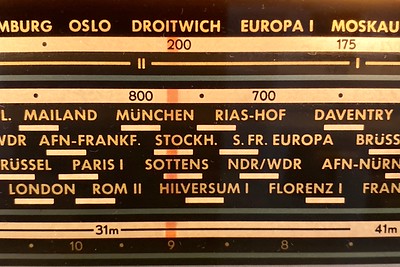
BBC Radio 4's long wave (LW) service, which reaches the British Isles and much of northern Europe from a 500,000 Watt transmitter on 198 kHz (and two supplemental 50 kW transmitters in Scotland), was discontinued earlier this year, on June 27, 2026. Radio 4 is the BBC's spoken-word service, which features news, literature, drama, and comedy. It may be the only station in the world that still produces content for the Theater of the Mind.
The end of LW radio had been anticipated for many years. The massive vacuum tubes (called glass valves in the UK) required for broadcasting at this power and frequency have not been manufactured for decades; only a few remain. The difficulty and cost of manufacturing new tubes or building a new transmitter from scratch coupled with a shift of listeners to other mediums combine to make the case for switching off.
A handful of specially crafted glass valves each measuring one metre high are all that is stopping the historic home of Test Match Special, Yesterday in Parliament and the Daily Service going suddenly and permanently off air.BBC Radio 4 long wave, which transmits on the 198 kilohertz frequency, relies on ageing transmitter equipment that uses a pair of the valves - no longer manufactured - to function.
The valves, at Droitwich in Worcestershire, are so rare that engineers say there are fewer than 10 in the world, and the BBC has been forced to buy up the entire global supply. Each lasts anywhere between one and 10 years, and when one of the last two blows the service will go quiet.
When they say long wave, they mean it. The wave length of a 198 kHz signal is 1515 meters, or just shy of a mile. By comparison, the signal of KRMG's FM signal at 96.5 MHz is 3.1 meters. (Divide the speed of light in meters per second -- about 300,000,000 -- by frequency in Hertz to get wavelength in meters.)
Most UK listeners hear Radio 4 these days on FM or on Digital Audio Broadcasting (DAB), both of which use frequencies in the VHF band and are therefore line-of-sight. There are 443 DAB transmitters across Britain. BBC multiplexes its national radio stations on 225.648 MHz. Rather than tuning a frequency, the listener chooses a station from a menu. A significant audience now listens via the BBC Sounds app, receiving the signal as mobile phone data.
Nevertheless, the long-wave transmitter reached audiences well beyond the reach of mobile phone towers and VHF signals. Oil platforms, freighters, and fishermen in the North Sea could hear the Shipping Forecast loud and clear over long wave from Droitwich. British expats and English-language learners across Europe could pick up the signal as well. In 2019, Richard Mudhar wrote of the value of AM radio during his hikes in remote parts of Wales, near Mt. Snowdon:
Since longwave and medium-wave coverage is almost universal in the UK, it can be heard by anyone anywhere. There are still regions where other types of radio broadcast cannot reach, making it an important lifeline. AM radio doesn't require an internet connection or 'phone signal, both of which can be unreliable. It can even be used by fisherman across the waters surrounding the British Isles to get all-important updates via the Shipping Forecast. In times of local power cuts, national crises and internet outages, AM radio remains resolute where other options fail. It is therefore a vital lifeline to bring news during crises.
198 kHz served other purposes. Millions of home electric meters listened for the daily signals to switch between low and high tariff rates, and appliances could listen to switch on and off to take advantage of the lower raes. Nuclear submarines could receive the signal without surfacing and thus could confirm that the UK had not been destroyed by a Soviet first-strike:
Because long-wave signals can penetrate seawater to a depth of several meters, Vanguard-class submarine commanders would regularly tune into the Today program on Radio 4 to make sure the country was still there. If the BBC and regular military channels went dead for more than 48 hours, the sub commander was authorized to open their sealed "Letters of Last Resort" from the Prime Minister.
Longwave's unique feature is its ability to travel large distances, owing to the size of the radio waves that it broadcasts. That means that a single transmitter can be used to serve an entire country and beyond - a remarkably efficient way to broadcast. This makes it the medium of choice for a climate-conscious age. Medium-wave cannot travel so far, and so requires more transmitters, but is still much more efficient than FM and DAB in this regard. To get the same coverage requires 100s of digital radio (DAB) or FM transmitters, which means a much greater cost of materials and energy required to make those broadcasts. AM (LW and MW) receivers use a fraction of the energy used by smartphones, computers, smart speakers and many DAB radios to receive the same programme.Since longwave and medium-wave coverage is almost universal in the UK, it can be heard by anyone anywhere. There are still regions where other types of radio broadcast cannot reach, making it an important lifeline. AM radio doesn't require an internet connection or 'phone signal, both of which can be unreliable. It can even be used by fisherman across the waters surrounding the British Isles to get all-important updates via the Shipping Forecast. In times of local power cuts, national crises and internet outages, AM radio remains resolute where other options fail. It is therefore a vital lifeline to bring news during crises.
The same groups are pushing to keep the BBC's remaining medium-wave (MW) transmitters on the air. 693 and 909 kHz broadcast BBC 5 Live, a talk-format station.
The magic of analog radio is that it doesn't require CPUs or specialized software or chips to encode, multiplex, demultiplex, and decode the signal. A simple, unpowered, crystal radio could pick up the long-wave signal and convert it back to sound waves. This is another example of Bates's Law of Creeping Technoslavery: A simple and robust technology is displaced by a more convenient but also more fragile system, to the point that it is no longer deemed cost-efficient to maintain the hardier fallback. The handful of users and use cases who aren't served by the new technology are lost in the transition.
Hillwalker Richard Mudhar expresses the problem concisely -- "driv[ing] innovation forward [while] driv[ing] resilience out":
More widely, market forces drive innovation forward but they also drive resilience out, concentrating things towards using the Internet for information delivery. I do wonder how well we would recover from a modern-day Carrington event, needing to black start a damaged Internet with a lot of satellite communications fried and limited power.
In the face of ridicule from know-nothings, the US House of Representatives did the right thing in passing the AM Radio in Every Vehicle Act last month. (Mandating NOAA weather radio would be another step forward.) The ubiquity of receivers makes it more reasonable for AM broadcasts to continue. Congress could do even better if they ensured that disused signals are available for members of the public to acquire for use. Clearing the former clear-channel frequencies for high-powered regional signals would be another favor to listeners in remote areas.
MORE: Some good comments on Richard Mudhar's essay and on Digital Spy about AM radio generally and LW in particular. One commenter mentions listening to NFL games in the UK over US Armed Forces Radio, broadcast on AM transmitters in West Germany during the Cold War. Those stations were taken off air in 2013 and the antenna masts demolished in 2015. Another commenter worries: "lf the internet were to go down due to war or other catastrophic events, we'd all be in the dark. No option to turn on a radio and keep in touch."
A friend recently posted a photo showing a large and longstanding pothole, aka chuckhole, aka chughole, that had been declared Lake DOT, with waterfront property for sale:

It's almost certainly an AI-enhanced photo, but it's funny, and it reminded me of the real-world, light-hearted things KOTV (Tulsa channel 6) would put in and around chugholes in the 1970s to dramatize the terrible state of Tulsa streets.
Back in 2012, when KOTV was moving from the 3rd and Frankfort farm equipment showroom it had been occupying since 1949 to the new Griffin Media HQ, the station posted a lot of video from their video archives.
This web article features 13 different examples of KOTV's long-running "Chughole of the Week" series, a regular feature on mid-1970s Friday night news broadcasts:
Time to take a peek into the video vault, back to the mid 1970s. Back then, viewers consistently called and complained about the condition of the streets, so we developed a Friday feature called "Chughole of the Week.Viewers nominated them, then one was selected to be featured on Friday. Reporters could be as creative as they wanted to be, so they took the opportunity to relax a bit, and have a little fun....
There was another chughole in April of 1975 they called the Academy-award winning chughole. They awarded a trophy - actually a basketball trophy, but you get the idea.
From Christmas Day of 1975, the Chughole of the Week came complete with wrapped gifts for "driving through a chughole wonderland." Told you reporters could let their creative imaginations run free.
Rex Daugherty was the face of chughole of the week lots of times. One week he interviewed a guy they called the "chughole watcher."...
In 1979, Daugherty likened a street full of chugholes to a football defense beating up on the neighborhood kids. He even had cheerleaders cheering the city on to chughole repair.
Over the years, many KOTV veterans wrote about the Chughole of the Week on TulsaTVMemories.com. In May 1999, John Hillis wrote:
Somebody asked about "The Chughole of the Week," a feature that was well-established by the time I arrived at KOTV, but was one of those things born out of desparation to fill that 60 minute newscast. You found a large hole in the street, and figured out a set-up to feature it.One gem that was before my time (which Doug Dodd told me about when I was there for my job interview) involved having the T-U men's chorus in full tuxes standing in a pothole on S. Yale, singing "The Whiffenpoof Song." Yale...get it?
Another was to use commercial spokesmen to do chughole pitches. I can still hear John F. Lawhon saying, "If you're looking for the best chughole buy in Oklahoma..." We also did holes with (I think) the Guy Henshall Shadetree Mechanic and the jeweler whose name escapes me, but we filled the hole with rhinestones for his thing and shot it with a star filter. It was in retrospect a kinda dumb feature, and we probably milked the situations too many times before we all finally ran out of ideas and variations (in short, a lot like TV today!), but it was uniquely Tulsa. I remember the consultants from McHugh and Hoffman visiting, watching it, and being puzzled, like it was in French or something. Like a lot of the back half of the 6 newscast, it was both deadpan, and ironic, (and a little weird) all at once. The deadpan and irony had a lot to do with Clayton, and obviously, the "Letters" segment he closed with was the primary example.
Clayton Vaughn let me do absolutely ANYTHING for a chughole of the week. Being a big goof, I thought it was great --- a chance to be silly in front of 100-thousand people every week.One week I got little toy wind up Godzillas and let them churn around in a chug hole -- I got some neighborhood girls to stand way down the street and run around screaming .... it was, how you say, "forced perspective."...
Once Clayton let me spend a hundred bucks to haul the KOTV grand piano out to a street off Admiral and Sheridan ... I hired a TU pianist, rented a tuxedo and bought "Mendelson's Spring Song" from Saied's music company. However, first -- and I never told Clayton this ... I wasted half a day seeing I could figure out how to play the song myself -- finally I called this guy I knew at TU to come do the deal.
It worked. The piano was kind of cockeyed in the chug - chuck hole ... and Dave played away. Clayton loved it.
The public disgust with the state of Tulsa streets led to the failure of a street-improvement bond issue in December 1975 and the decision of Sid Patterson, Commissioner of Streets and Public Property, not to seek a third two-year term in 1976:
Patterson said he has been ambivalent in recent weeks about whether to seek election to his third consecutive term as street commissioner, a post he called Monday a "no-win job." "I want to get out from under this 'chughole joke," Patterson said. "I think there's been a character assassination that's made my image a joke in the community."His official announcement mentioned frustrations and gratifications of the past four years. Patterson said he's pleased to have been part of the start of programs such as a systematic street maintenance program, a tree-planting effort, and the upsurge in efforts to solve flooding and drainage problems....
Patterson showed disappointment with the recent defeat of his second proposed street bond issue. He said he is "discouraged with the rumors ... the old myths and the old lies such as 'I'm against voting money for new streets until they fix the old ones.'
Shortly after Patterson was elected in 1972, an administrative reorganization of the street commissioner's departments placed virtually all units under control of City Engineer Harold Miller. A strain between Patterson and Miller has been openly discussed at City Hall since.
Chugholes were also a topic of contention during the 1976 mayoral debate, in which incumbent Mayor Bob LaFortune took flack from his primary opponent Mary "Sunshine" Watson and Democrat challenger Betsy Horowitz:
Both feminine candidates got some licks in at the mayor before he arrived. LaFortune explained he thought the meeting, which began at 10 a.m., was scheduled for 10:30.Mrs. Horowitz leveled her guns at chugholes and flood control programs as well as the city's crime problem.
"Where has your money gone?" she asked. "Why has our administration spent money on studies and statues in front of fire stations when there was not enough to repair the city's streets? I warned of floods in 1970, but in 1974, people were sitting on their roofs while the city was spending money on Riverpark and $26 million to build a 200.
"I like animals and pretty parks as well as anyone, but I think our priorities are out of order. I have made bureaucracy work from the outside. Think what I could do from the inside." Mrs. Horowitz said she would publish city financial reports quarterly, install a suggestion box for citizens and operate one day a week from a mobile office "that would go where the people are."
Looking back, the dire state of the streets in the mid-1970s might reflect the costs the city imposed on itself after the massive 1966 annexation, which tripled Tulsa's area overnight. Tulsa leaders continued to push for expressway construction, River Parks, and a new 71st Street bridge over the Arkansas River, instead of focusing on basic needs.
EDITOR'S NOTE 2026/09/20: Four nights ago, as I was nearly done editing this entry, my hosting provider decided it was time to upgrade the server, including a new version of the language on which the content management system for this blog depends. Features that had been deprecated but legal were suddenly illegal. While the site itself remained in operation (thanks to my stubborn insistence on static pages and a minimum of dynamic content), I could neither add new content or edit existing content. There wasn't a coherent list of problematic syntax, so there was a lot of trial and error. Four days later (amidst many other responsiblities and problems), as of a few minutes ago (approximately 11:15 pm, 2026/09/20), I managed to fix the last of the newly-illegal syntax, and the login prompt has returned. Praise the Lord!
Today was the 25th anniversary of the Islamic attacks on America. We pause to remember the husbands and wives, sons and daughters who died that day and in the years since in the pursuit of the evil ideology that inspired and motivated the attacks.
Tonight over dinner, I shared my memories of 9/11 with my younger two children, who are among the third of the American population today who are not old enough to have any memory of the events. I brought to the table a commemorative model of the World Trade Center that was given to our family as a memorial and a token of appreciation from the family of Jayesh Shah. Jay Shah was a Memorial High School and University of Tulsa alumnus who had only earlier that year moved from Houston to New York City to take the post as vice president for technology for Cantor Fitzgerald's eSpeed division in the upper floors of the North Tower of the World Trade Center.
Please take a moment to say a prayer for Jay's family, who still deeply miss their brother, son, husband, and father. About 30 members of the Shah family returned to the National 9/11 Memorial, participating once again in the reading of the names of the dead. In 2022, Jay's daughter Nikita told the Associated Press that the family comes back for the annual commemorations to be "around people who kind of experienced the same type of grief and the same feelings after 9/11." The town of Edgewater, New Jersey, where the Shah family lived in 2001, was to hold a 25th anniversary commemoration in memory of Jay and two other Edgewater residents who perished in the attack.
This 2002 story from the Houston Chronicle tells about Jay's family and their desperate search through the streets of New York for hopeful news that never came. In 2006, the Shah family presented a memorial flag, made up of the names of those who died, to the children's elementary school in Katy, Texas. In 2016, Jay's daughter Sonia, then a senior at Baylor University, spoke to the Associated Press about how the death of her father has motivated her to serve refugees.
I've come across many thoughtful essays and remembrances this past week:
Julie Neidlinger boarded a westbound train on September 10, 2001, and she ponders the contrast between all the good of the day before and the day of the disaster.
The tenth is always good. It is the day before. The day before someone you loved died. The day before you lost your job. The day before the accident. The day before the assault. The day before you get the diagnosis. The day before the bad news, the truth revealed, the hopes crushed. The day before your entire life collapses.The tenth was good, but I didn't know it at the time. I didn't know the eleventh was coming, so I wasted the value of the tenth. The tenth is worth more than all the gold in the world once you find yourself in the eleventh.
But, Julie notes, the eleventh is not the end of the story, just as Good Friday was not the end of that story.
Mary Katherine Ham remembers the children on the planes who died on 9/11, including preschoolers heading to Disneyland and three eleven-year-olds who had won a trip with National Geographic to the National Marine Sanctuary near Santa Barbara. She writes:
The hijackers of both planes would have seen these children in the waiting area and in their seats. Neither flight was full and it would have been obvious. But to them, the sacrifice of toddlers was part of a pious religious observance, by which they would go to paradise for the punch they landed against Western Civilization by blowing up children going to Disneyland. In a final act of anti-Western, anti-Semitic, Islamist fanaticism, they bathed ritually, read the Qur'an, prayed together, and murdered these babies.
She also calls attention to comments made by Ramzi Kassem, blaming American foreign policy for the attack less than a week after it happened. Today Kassem is chief counsel to New York City Mayor Zohran Mamdani. Ham comments:
The intellectual father of radical Islam and [Al-Qaeda] was inspired by what he considered the grotesque green lawns, attractive women, and "tapping feet, enticing legs, arms wrapped around waists" of the scandalous sock hops of Greeley, CO in 1949, but go on, counselor.
She quotes Sayyid Qutb, the Egyptian who called for violent jihad against modernity and the West. Qutb was a graduate student in the United States in the 1940s. He was scandalized by a sock hop at a church in Greeley, Colorado:
The dance floor was lit with red and yellow and blue lights, and with a few white lamps. And they danced to the tunes of the gramophone, and the dance floor was replete with tapping feet, enticing legs, arms wrapped around waists, lips pressed to lips, and chests pressed to chests. The atmosphere was full of desire.
Gerald Posner, author of Why America Slept, has published a "9/11 Conspiracy Debunker's Guide," in which he summarizes the evidence rebutting the various claims that 9/11 was a false flag attack, that the World Trade Center was felled by a controlled demolition, that the Pentagon wasn't hit by an aircraft, that Jews were warned to stay away from the World Trade Center, among other claims.
So here is the short pocket guide I wish someone had handed me twenty years ago. It would have saved me a lot of time. It is not a comprehensive long-form refutation of each theory and nuance raised in the past quarter century but is instead a primer that will hopefully serve as a starting point for rational debate about what happened on 9/11. Also, it is not a defense of the government's account. I have spent a career criticizing that, and I'll get to where it fails later. First, however, I want to provide a method for sorting the claims.
If you'd prefer a video version, Posner was interviewed last week on PragerU's The Brief.
Posner also delves into the open questions concerning the involvement of Saudi royals in supporting the attacks.
There is a real, documented, evidentiary case about foreign government involvement in 9/11. It is not on YouTube. It is in a federal courthouse in Manhattan....In Why America Slept, the final chapter is about the interrogation of Abu Zubaydah, then believed to be one of al-Qaeda's most senior figures. He was captured wounded in Faisalabad in March 2002, and I broke the story in my book about his questioning under a false-flag operation in which American personnel posed as Saudi security officers. Instead of being afraid of being in "Saudi" custody, he was relieved and asked his interrogators to call a senior member of the Saudi royal family. He gave them a private home number and a cell number from memory. That was Prince Ahmed bin Salman bin Abdulaziz, King Fahd's nephew and the head of the Kingdom's largest media company. The telephone numbers were real. Pressed further, Zubaydah named two more Saudi princes and the chief of Pakistan's air force as his high-level contacts. He again gave their telephone numbers from memory and said that two of the men had known that a major operation was coming against America. One investigator told me that Zubaydah's monologue was the Rosetta Stone of 9/11.
Within roughly a year all four were dead....
Posner posted a clip from today's reading of the names of the dead. 9/11 widow Terry Strada "called out Saudi Arabia's role, the broken promises, and a string of administrations that protected the Kingdom instead of helping to deliver justice for the families."
Somewhat related, Steve Sailer posted excerpts from articles he wrote during the 2000 presidential election about pledges both George W. Bush and Al Gore made to eliminate ethnic profiling of air travelers, a gesture to appease Arab Americans who were, at that time, majority Christian. At 3 pm on 9/11/2001, President Bush was due to meet at the White House with representatives of Arab-American and Muslim organizations to discuss this and related policies involving deportation. Waller, who was working in an office sublet from Grover Norquist's Americans for Tax Reform, gives his eyewitness account that the meeting went ahead without Bush, who had taken refuge at Barksdale AFB. The meeting was moved to Grover Norquist's conference room, and attendees included members of the Muslim Brotherhood and Sami al-Arian of the Palestinian Islamic Jihad, who "was later tried and convicted of terrorism-related charges, served some prison time, and was deported." Waller says that Norquist credited al-Arian for turning out the votes in Tampa's Muslim community to give Bush a narrow win in Florida.
The staff of Legal Insurrection remembers where they were on 9/11. Jane Coleman recalls a visit to the World Trade Center with her husband Ron Coleman and their sons just two months earlier, where she was haunted by fears of a recurrence of the 1993 attack.
Ron Coleman has re-posted on X his memories of being in midtown Manhattan during the attack, the confusion of the day, the parade of refugees walking north from the zone of destruction, and the journey to get back to his car, across the river in New Jersey, and atop the Palisades.
(Ten years ago Ron published his memories in five parts on his blog, Likelihood of Success. Part 1: When the planes hit; Part 2: The confusion of the day; Part 3: Starting the journey home; Part 4: The walk to the river and Part 5: The ferry, the stairs, and home.)
Some items from past anniversaries worth revisiting:
Jennifer Senior published a moving feature story in the September 2021 issue of The Atlantic: "What Bobby McIlvaine Left Behind." McIlvaine was her brother's roommate in college and apartment-mate on September 11, 2001. She traces the way his mother, father, brother, and fiancee have each dealt with their grief and with the notes and ephemera he left behind.
Tom Junod's story in Esquire from 2016 is worth re-reading: "The Falling Man: An unforgettable story." It is the story of the famous photograph of a man who has jumped or fallen from the World Trade Center, plunging headlong, vertically through the air, paralleling the vertical lines of the two towers. Junod pursues the photographer (who also photographed the dying Robert F. Kennedy, the photographs, and the mystery of the identity of the man in the photograph.
...the only certainty we have is the certainty we had at the start: At fifteen seconds after 9:41 a.m., on September 11, 2001, a photographer named Richard Drew took a picture of a man falling through the sky--falling through time as well as through space. The picture went all around the world, and then disappeared, as if we willed it away. One of the most famous photographs in human history became an unmarked grave, and the man buried inside its frame--the Falling Man--became the Unknown Soldier in a war whose end we have not yet seen. Richard Drew's photograph is all we know of him, and yet all we know of him becomes a measure of what we know of ourselves. The picture is his cenotaph, and like the monuments dedicated to the memory of unknown soldiers everywhere, it asks that we look at it, and make one simple acknowledgment.That we have known who the Falling Man is all along.
Bookworm Room remembers Rick Rescorla, head of security of Morgan Stanley Dean Witter, who anticipated another attack after the 1993 bombing, relentlessly drilled employees in evacuation procedures, and on the day, guided the 2,700 workers to safety, losing only six, including himself and two members of his team, who went back in the building one last time to make sure they had everyone out. Powerline has a tribute to Rick Rescorla, with more about his earlier life as a soldier in Vietnam and links to other tributes. I learned today from Parker Thune that Rescorla, originally from Cornwall, earned his bachelor's and master's degrees from the University of Oklahoma. A commenter said that Rescorla was in the Oklahoma National Guard and was a tough TAC officer when the commenter's father attended Officer Candidate School there. Does OU have any memorial honoring Rescorla?
In 2017, Yahya Cholil Staquf, the head of the largest Muslim organization in Indonesia, the country with the largest population of Muslims, told an interviewer that the West needs to acknowledge the connection between orthodox Islam and violence:
Western politicians should stop pretending that extremism and terrorism have nothing to do with Islam. There is a clear relationship between fundamentalism, terrorism, and the basic assumptions of Islamic orthodoxy. So long as we lack consensus regarding this matter, we cannot gain victory over fundamentalist violence within Islam.Radical Islamic movements are nothing new. They've appeared again and again throughout our own history in Indonesia. The West must stop ascribing any and all discussion of these issues to "Islamophobia." Or do people want to accuse me -- an Islamic scholar -- of being an Islamophobe too?...
Too many Muslims view civilization, and the peaceful co-existence of people of different faiths, as something they must combat. Many Europeans can sense this attitude among Muslims.
There's a growing dissatisfaction in the West with respect to Muslim minorities, a growing fear of Islam. In this sense, some Western friends of mine are "Islamophobic." They're afraid of Islam. To be honest, I understand their fear ... The West cannot force Muslims to adopt a moderate interpretation of Islam. But Western politicians should stop telling us that fundamentalism and violence have nothing to do with traditional Islam. That is simply wrong.

Article XXIV, Section 2, of the Oklahoma Constitution states (emphasis added):
No convention shall be called by the Legislature to propose alterations, revisions, or amendments to this Constitution, or to propose a new Constitution, unless the law providing for such convention shall first be approved by the people on a referendum vote at a regular or special election, and any amendments, alterations, revisions, or new Constitution, proposed by such convention, shall be submitted to the electors of the State at a general or special election and be approved by a majority of the electors voting thereon, before the same shall become effective: Provided, That the question of such proposed convention shall be submitted to the people at least once in every twenty years.
This language has not changed since the Constitution was approved in 1907.
Oklahoma Gov. Kevin Stitt has issued an executive order calling for a referendum on April 6, 2027, to ask the voters, for the first time since 1970, whether or not a Constitutional Convention should be called:
Oklahoma City (August 26, 2026) - Governor Stitt yesterday took action to comply with the Oklahoma Constitution and send to a vote of the people the question of whether the legislature shall call a constitutional convention, as required by Article XXIV, Section 2 of the Oklahoma Constitution.Article XXIV, Section 2 requires that the people of Oklahoma be given the opportunity at least once every twenty years to decide whether or not to move forward with a constitutional convention. The question was last presented to Oklahomans in 1970, depriving Oklahomans of this constitutional right.
"The Oklahoma Constitution is clear. At least every 20 years, Oklahomans have the right to decide whether it's time to call a constitutional convention," said Governor Stitt. "It's been 56 years since the question was sent to the people. This action puts the question to the people and ensures Oklahomans finally get the opportunity their Constitution guarantees."
The Executive Proclamation sets a special election for April 6, 2027, and was accompanied by Executive Order 2026-30, which instructs the Secretary of State to take any action necessary to submit the question to the people and creates the Oklahoma Constitutional Convention Commission. The Commission is tasked with studying the Oklahoma Constitution and other state constitutional conventions, then making recommendations about the procedures and rules that would govern a state constitutional convention, should the state question be approved. The Commission will also consider necessary safeguards and proposed legislation needed to implement a convention.
The report will be due no later than December 31, 2026.
"Oklahomans have the right to review our Constitution and determine whether it's time to consider changes," continued Gov. Stitt. "It is time to honor that right and give Oklahomans the choice our state founding fathers guaranteed to them."
The executive proclamation setting the special election can be found here: https://www.sos.ok.gov/documents/filelog/98225.pdf [NOTE: There was a typo in the URL in the press release, which I have corrected.]
Here is the question that would be put before the voters, as State Question 848:
Shall the Legislature call a Constitutional Convention which shall be authorized to propose alterations, revisions, or amendments to the Constitution, or to propose a new Constitution for the State of Oklahoma?
In his executive order, Gov. Stitt quotes Robert L. Williams, the first Chief Justice of Oklahoma and a delegate to the Oklahoma Constitutional Convention, who wrote in his commentary on the Oklahoma Constitution regarding Article XXIV, Section 2: "Being self-executing, it is the duty of the Secretary of State, without any additional legislation, to submit this question every 20 years to the electors of the state." Williams says, "This section was patterned after Oregon (1857) 17, 1 and 2, as amended," and also makes reference to "Md. (1867) 14, 2; Mich. (1850) 20, 2 [now in Article XII, Section 3]; N. Y. (1894) 14, 2 [now in Article XIX, Section 2]; Ohio (1851) 16, 3; S. C. (1895) 16, 3; and Utah (1895) 23, 2 and 3."
Michigan, New York, Ohio, and South Carolina have a requirement to put the question of a constitutional convention before the voters at regular intervals. New York has held six constitutional conventions, with the 1938 convention producing a new constitution that was ratified by the voters, while the propositions submitted by the 1967 convention were rejected by the voters.
Feeds
 Subscribe to this blog's feed:
Support BatesLine
Show your appreciation and help fund hosting and research expenses:

Show your appreciation and help fund hosting and research expenses: